When Svalbard Museum moved into the Research Park in 2005, artefacts from several earlier archaeological excavations on Svalbard were brought back to Longyearbyen. Objects that had been both in Norway and abroad were incorporated into the museum’s collection. Many of these objects arrived at the museum in a frozen state and have since been stored in the museum’s freezer room. There they have remained deep-frozen and well preserved, but completely inaccessible to both researchers and the public.
Now all this archaeological material is being taken out of the freezer, conserved, and moved into the museum’s storage facilities. The project is called “Making Frozen Archaeological Artefacts Accessible”, or simply “the freezer project” on a daily basis. Until recently, the museum had neither the capacity nor the equipment required to carry out the necessary conservation work. But with support from the Svalbard Environmental Protection Fund and its own resources, the museum was able in 2023 to hire a conservator and begin the major task of emptying the freezer. Today, the museum has one permanently employed conservator and one conservator hired specifically for the project, both working on this effort.
- 1/1
The conservators Unn Gelting and Mette Klüver Rognsted in the museum laboratory.
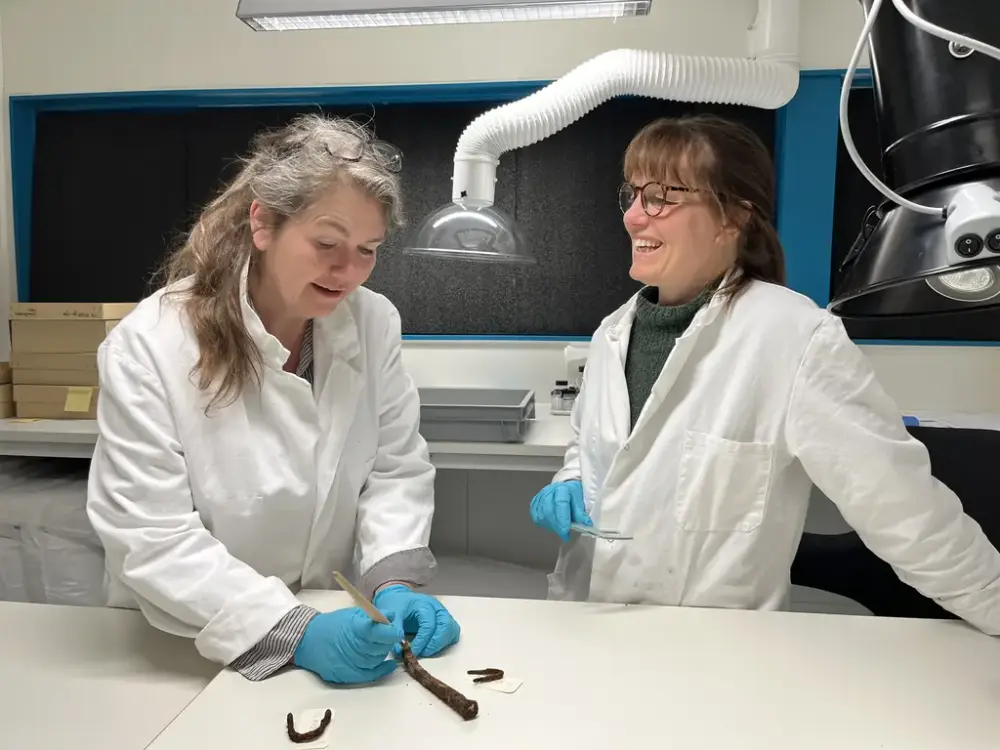
More than 2,100 object numbers—and in reality many more physical objects—have thus been stored in a frozen state awaiting conservation. As long as the objects are sealed airtight in plastic or frozen in various chemical solutions, they remain well preserved in the freezer. But once an object is removed from the freezer, it must be conserved to prevent damage or deterioration.
The work is time-consuming. Each item is taken out of the freezer room, unpacked, thawed, assessed, registered, catalogued, and photographed. The need for conservation varies. Some objects require only light cleaning and controlled drying, while others need more extensive treatment. After conservation, each object is packed and placed in its new storage location. Finally, a short report is written for every object processed. The storage rooms they enter are climate-controlled to ensure the best preservation conditions. For organic materials, 50% humidity is optimal. Metals, ceramics, and glass are stored in a dry room where humidity should be around 15%.
As part of the project, the museum is also assessing which objects require external conservation. It is estimated that about 5–10% of the objects in the freezer require conservation that cannot be carried out on Svalbard. During the project, two particularly challenging groups of objects have been identified: textiles and wooden items.
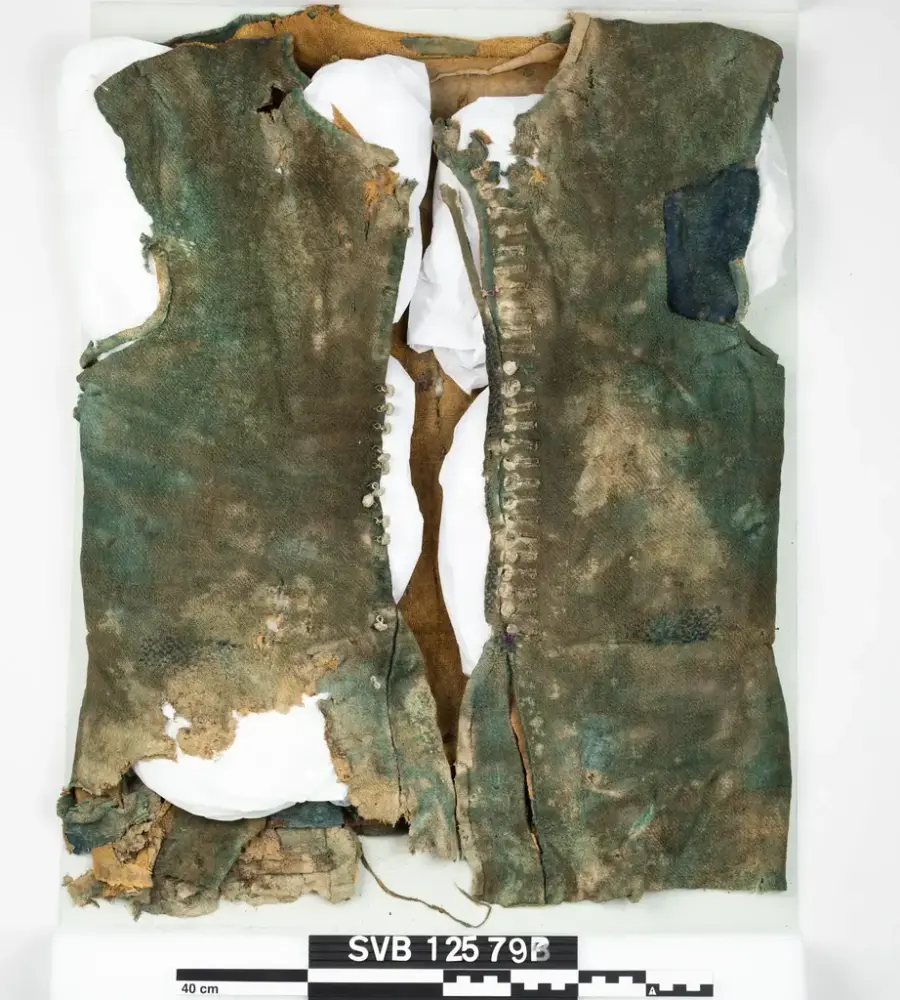
Svalbard Museum holds a substantial number of unique textiles, including stockings, trousers, and jackets from the 17th and 18th centuries, found in archaeological excavations of whalers’ graves. Such old garments would normally have rotted away long ago, but in Svalbard’s permafrost they have survived. The textiles at the museum, however, have an urgent need for conservation requiring specialised expertise. Some textiles will therefore be sent to Studio Västsvensk Konservering in Gothenburg, where the necessary expertise and equipment for textile conservation are available.
- 1/1
This whaler’s jacket from Likneset will be conserved in Gothenburg. The jacket’s sleeves have been stored separately.
Wooden objects present their own challenges, as wood easily cracks when it dries. The method for conserving wood is therefore to impregnate the items with polyethylene glycol (PEG), a water-soluble consolidant. The objects must remain in a PEG bath for six months, after which they are freeze-dried. Since the museum does not have equipment for the drying process, the wooden objects will be sent for freeze-drying at the NTNU University Museum in Trondheim once they have been impregnated.
During the freezer project, the returned materials have been systematised, giving the museum far better oversight than it had before the project started. The conservators have become well acquainted with the material and with how Svalbard’s special preservation conditions affect it.
To understand Svalbard’s history, researchers need archaeological material to study. Material from the freezer project has already proven useful in the Norwegian Institute for Cultural Heritage Research (NIKU) project “Investigations of climate change and degradation of archaeological cultural environments in Svalbard (CLIMARCH)”.
Every day, the museum’s conservators make progress in conserving the archaeological material, ensuring that it is preserved for the future. And as soon as an object is out of the freezer and fully conserved, it becomes available for new research.